

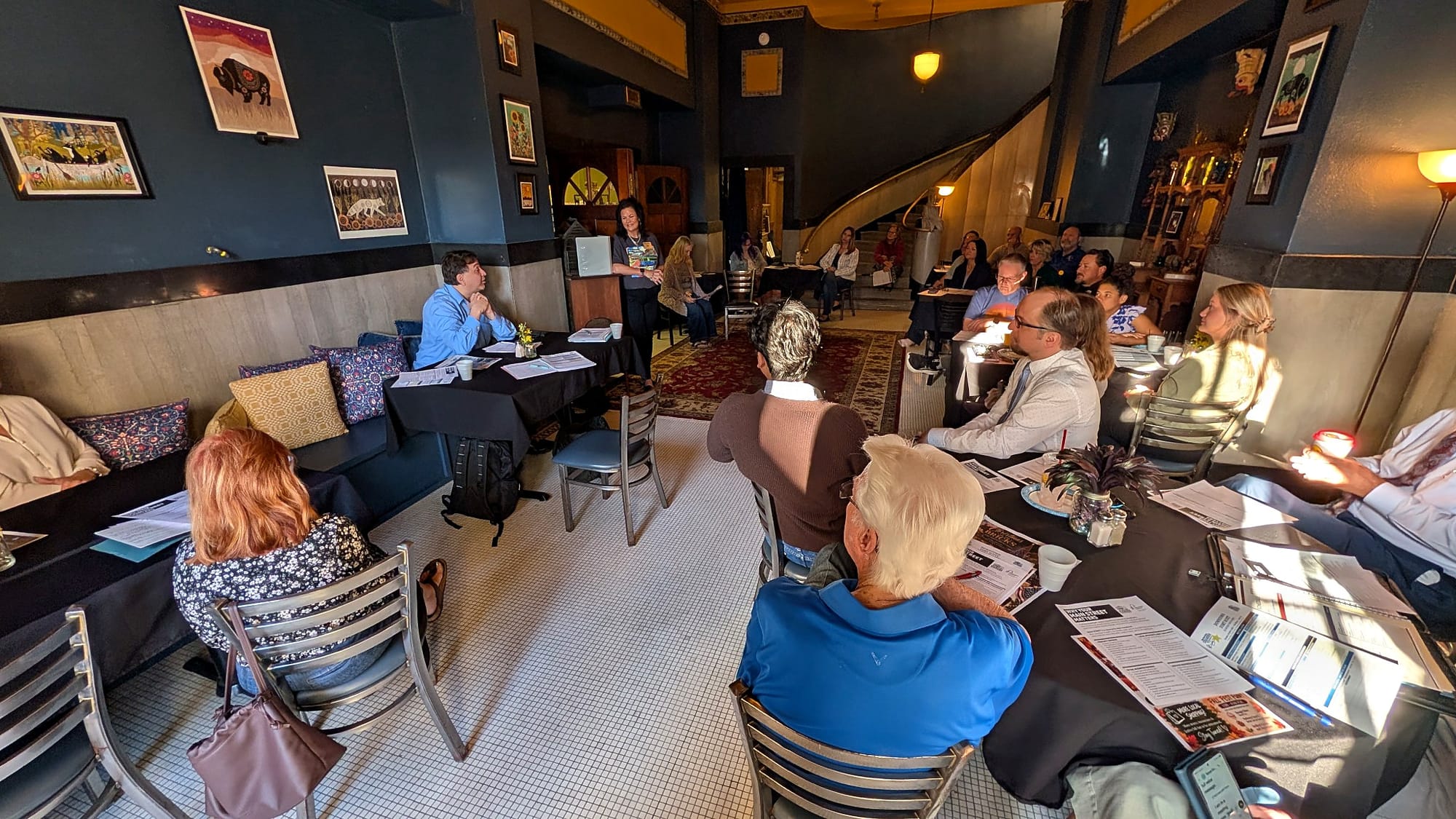
FORT SCOTT — Kansas Main Street State Director Drew Simpson told a packed Quarterly Downtown Meet & Greet on Tuesday that enforcing building codes on vacant downtown properties and retaining a well-paid Main Street director are essential to the city's downtown revitalization efforts.
Simpson, who spent 10 years with the Georgia Main Street program before taking the Kansas post, said he had never seen so many people at a community meeting.
Lindsay Madison, president and CEO of the Fort Scott Area Chamber of Commerce, gave Simpson a tour of downtown before he spoke.
Simpson said Kansas Main Street will make a baseline visit next year, distribute community questionnaires the following year and return for progress and alignment visits to assess whether the local strategy is working.
The state provides guidelines and guardrails, Simpson said, but Madison leads the local effort. The state's role is not to tell property owners or business owners what to do.
He also told attendees that once a city makes a visible effort to address a few vacant buildings, other owners often follow suit because they can see the city is serious.
What is the Main Street Program?
In an interview afterward, The Bourbon County Monitor asked Simpson to describe the Main Street program in a nutshell.
“A door for economic opportunity,” he said.
Simpson outlined the program's four pillars: design; organization, which can involve a board or volunteers; promotion of downtown locally and beyond; and economic vitality.
Economic vitality means examining vacancies and recognizing that a downtown thriving today may not be thriving in five or 10 years, he said.
He pointed to Greenville, South Carolina, which he said began planning its downtown revitalization in the mid-1960s and now has upscale boutiques, restaurants, parks and a downtown hotel to show for it.
“It just shows you that with great forward thinking and planning, you can do wonderful things,” Simpson said.
Code Enforcement
Asked about enforcing building codes in older downtown properties, Simpson was unequivocal.
“I think you have to,” he said.
To explain why, Simpson described a property owner whose neighbor's roof has collapsed, turning the building next door into what he called a catchment area for rainfall.
“That rainfall's going to go somewhere, and it's going to go in your building,” he said.
The neighboring owner's insurance costs rise and property value falls, Simpson said, through no fault of their own. Meanwhile, that owner continues paying property taxes and looks to the city for help.
“Why should you have to do that? ‘You shouldn't’ is the answer,” he said.
The city's responsibility, Simpson said, is to tell the owner of the deteriorating building to repair it, sell it or demolish it because it is damaging surrounding properties.
Losing a building, however, does not have to mean losing its contribution to downtown's character.
“So we had a building in one of the cities I was in that fell down, but we kept the facade,” Simpson said. “Your downtown is your smile, okay? And we know dentistry is not cheap.”
Removing a building takes away part of that smile, he said, and it is never quite the same. Preserving the facade, however, is like adding a crown.
“Then that smile gets regained again,” Simpson said. “I'm not sponsored by any dentist, by the way.”
Main Street Director Retention
Simpson also emphasized the importance of retaining a Main Street director, saying the average director stays just 18 months to two years before leaving, often for better pay in the private sector.
The average salary is about $54,000, he said, a figure he would like to see increase.
“Your Main Street director has to be a permanent fixture, and they have to be paid well, and they have to have benefits,” Simpson said. “Otherwise they'll move, and you'll lose that continuity.”
Some directors work for cities, while others are employed by nonprofits, Simpson said. In Georgia, about 95% of Main Street programs operate through city government, making directors city employees with access to municipal benefits.
“I think that's really, really important to continue the longevity of an executive director,” he said.
Having a director who stays five or 10 years, Simpson said, can be a tremendous asset to a downtown.
Downtown's future matters. So does local journalism.
From downtown revitalization to decisions at City Hall, The Bourbon County Monitor is here to keep you informed. Help sustain independent local reporting for just 25¢ a day.


