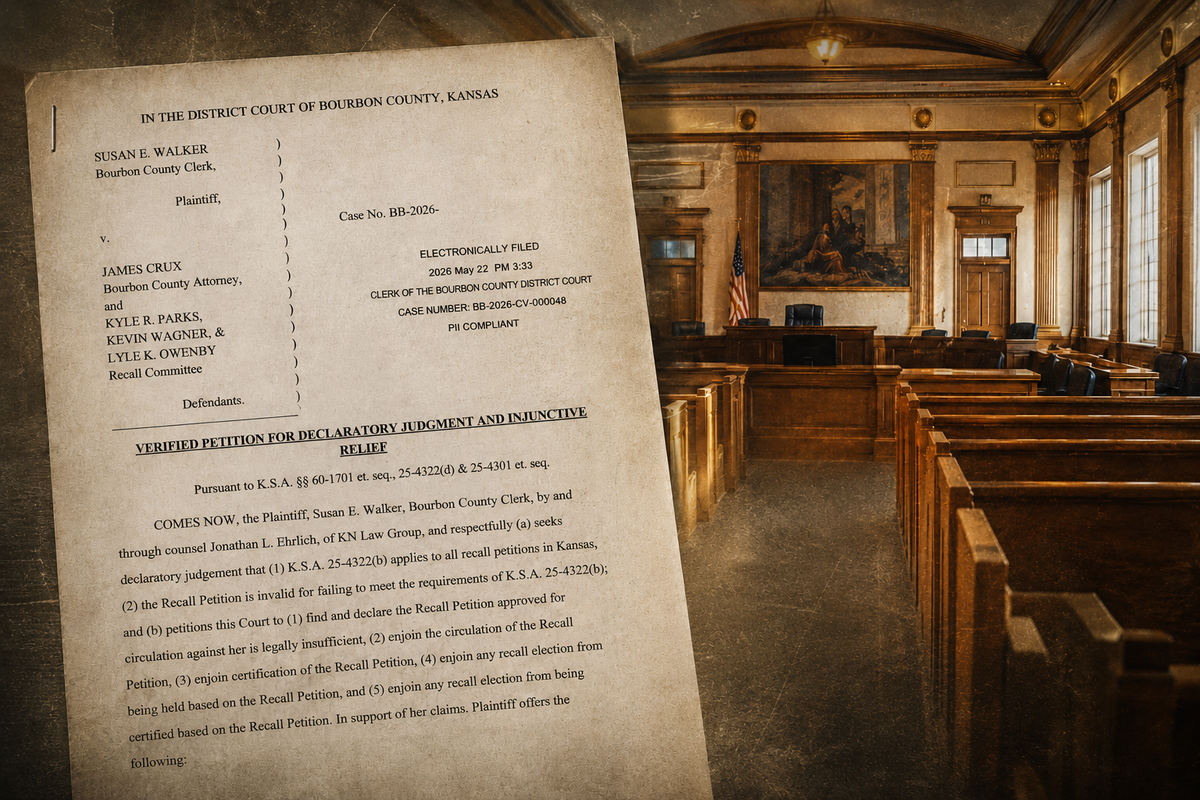
FORT SCOTT, Kan. — Bourbon County Clerk Susan Walker has dropped her legal effort to stop residents from circulating a recall petition against her, focusing her lawsuit exclusively on Bourbon County Attorney James Crux.
The change unfolded Thursday afternoon through a series of court filings, one day after a recall committee member filed a motion arguing that the clerk's lawsuit improperly targeted protected activity under the state's public speech protection law.
Free Speech Challenge
Recall committee member Kevin Wagner filed a motion Wednesday to throw out Walker's lawsuit under the Kansas Public Speech Protection Act. The law, known as an anti-SLAPP statute — short for "strategic lawsuit against public participation" — is designed to protect people who speak out, organize or petition the government from retaliatory lawsuits.
Wagner, represented by attorney Patrick B. Hughes, argued that Walker's lawsuit and her requests to halt the recall did exactly that, by targeting activity the Constitution protects.
The motion triggered an automatic pause under Kansas law, immediately freezing all discovery, pending motions, and scheduled hearings. Wagner asked the court to enforce this statutory stay, effectively blocking Walker’s request for an emergency order to stop the petition drive .
Walker Retracts Restraining Order Requests, Moves to Dismiss Recall Committee Members
Walker's attorney Jonathan Ehrlich filed a motion Thursday afternoon to dismiss Wagner and fellow committee members Kyle R. Parks and Lyle K. Owenby from the lawsuit.
With the filing, Walker withdrew her applications for a temporary restraining order and ended her effort to stop the committee from gathering signatures. The motion stated that the committee is no longer a necessary party to the remaining claims.
Refocus on the County Attorney
About 40 minutes earlier, Walker filed an amended petition naming Crux as the sole defendant.
The amended lawsuit asks the court to declare the recall petition invalid. Although Walker dropped her bid to stop circulation of the petition, she has still asked the court to bar certification of any signatures, any recall election based on the petition and certification of any such election's results.
Walker alleges that while Crux issued a sufficiency determination on an initial draft of the recall petition in late April, the committee then circulated a revised second draft. Walker contends that Crux never reviewed or issued an official, written determination letter for the second petition, as required by Kansas law.
The latest court filings from Wagner and Walker are linked below:
Previous stories about the recall attempt and subsequent court actions:
 Nick Graham
 Nick Graham
 Nick Graham